

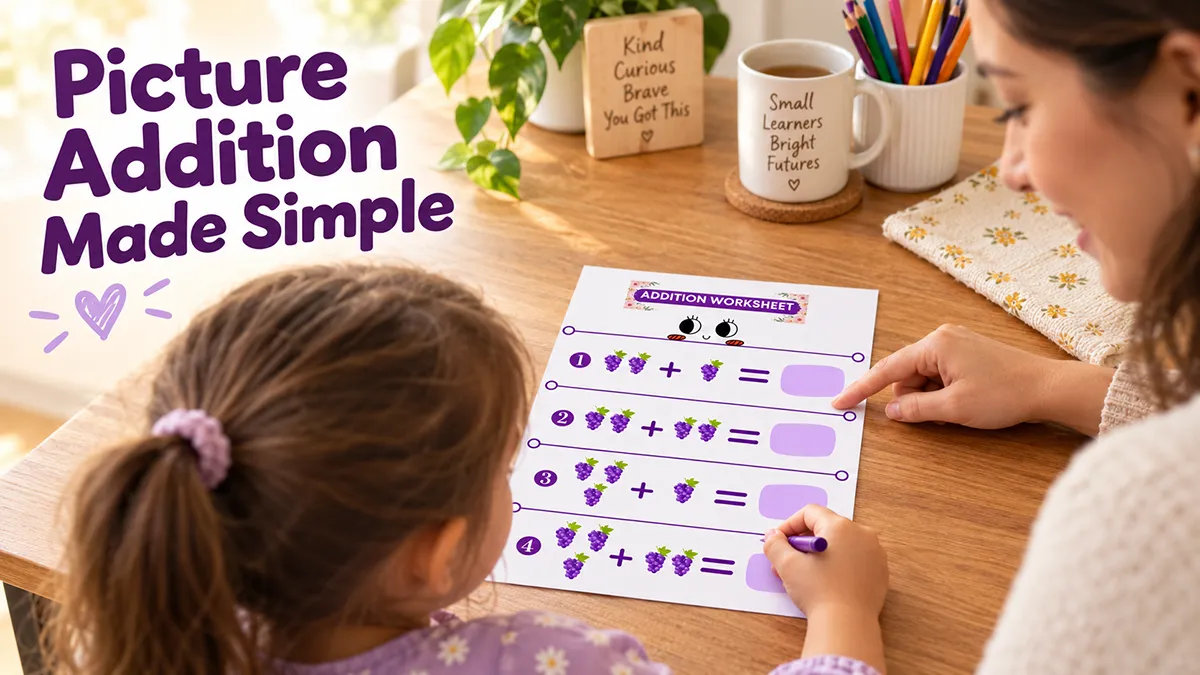
Quick Answer Box
To teach picture addition effectively, guide your child through the Concrete → Pictorial → Abstract learning progression. Start by asking them to count the first group of objects, then the second group, and finally count all objects together to find the sum. Connecting visual objects to numerical symbols (3 + 2 = 5) helps children see what the numbers mean, builds number sense, and gives them a starting point for addition.
Table of Contents
- Why Picture Addition is the Ultimate First Step in Math
- The Concrete to Pictorial Progression: Building Number Sense
- 4 Visual Steps to Teach Picture Addition at Home
- Playful Picture Addition Activities & Techniques
- Choosing the Right Picture Addition Worksheets
- Parent Troubleshooting: Common Pitfalls & Quick Solutions
- Frequently Asked Questions (FAQs)
- Final Thoughts
Why Picture Addition is the Ultimate First Step in Math
When young children first encounter math, numbers like 3, 5, or 8 are abstract symbols with no inherent meaning. If you show a 4-year-old the equation 3 + 2 = 5, they may feel confused because 3 and 2 do not yet represent physical quantities in their mind.
This is where picture addition serves as a vital bridge. By using pictures of familiar items, such as apples, stars, balloons, or grapes, children connect the physical act of counting objects to the mathematical concept of combining sets.
When learning how to teach picture addition, the primary objective is not speed; it is helping the child visualize that addition means putting two groups together to make a larger group.
The Concrete to Pictorial Progression: Building Number Sense
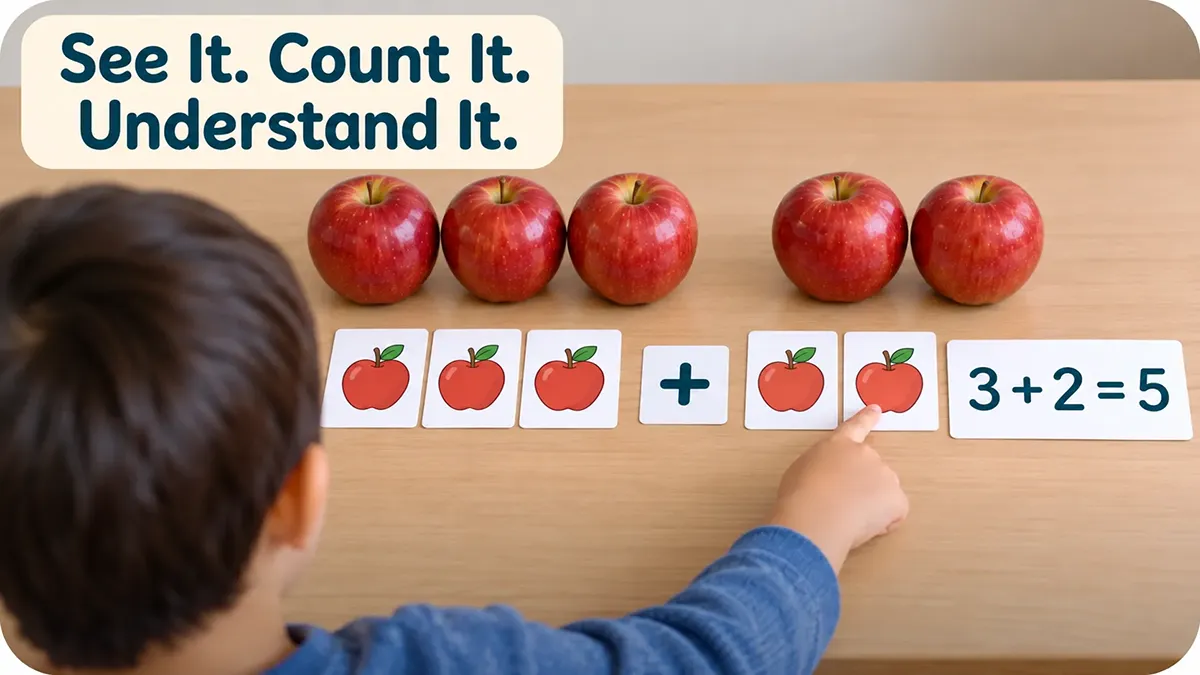
You can show the same addition using real objects, pictures and written numbers. This is called the Concrete, Pictorial and Abstract (CPA) approach:
- Concrete Stage (Hands-On Manipulatives): Children physically touch and move real items like building blocks, counting bears, or buttons.
- Pictorial Stage (Visual Representations): Children transition from real items to printed illustrations on a page (picture addition).
- Abstract Stage (Numerical Equations): Children solve math problems using written numbers (3 + 2 = 5) and operational signs (+ and =).
Help your child connect real objects, pictures and written numbers. For example, place three blocks beside two more, count all five, and show how they match 3 + 2 = 5. Keep objects or pictures nearby whenever your child needs them.
4 Visual Steps to Teach Picture Addition at Home
Follow these simple, step-by-step instructions to introduce picture addition without overwhelming your child:
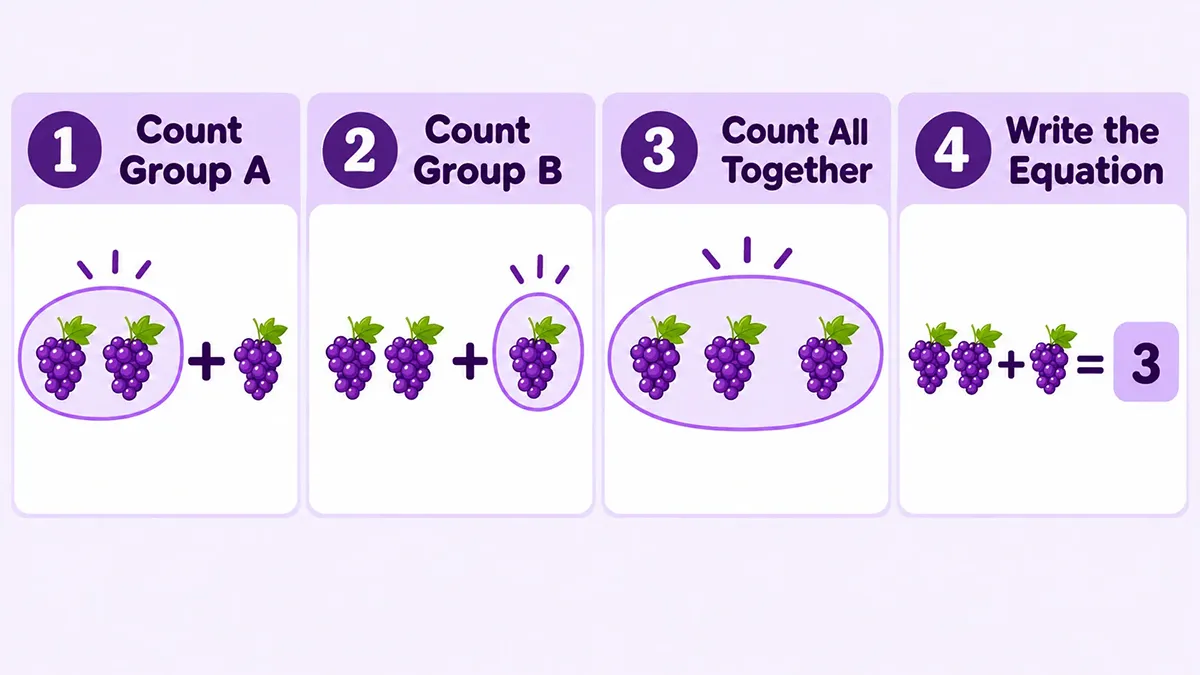
Visual Learning Flow: Step 1: Count Group A → Step 2: Count Group B → Step 3: Count All Together → Step 4: Write Equation
This example uses groups on the left and right. On a vertical worksheet, count the top group first, then the bottom group.
Step 1: Count the First Group (Left Addend)
Point to the first cluster of pictures on the left (e.g., 3 apples). Ask your child to point to each apple individually and count out loud: “One, two, three.” Have them write or place the number 3 directly below that group.
Step 2: Count the Second Group (Right Addend)
Point to the second cluster of pictures on the right (e.g., 2 apples). Have them touch each image and count out loud: “One, two.” Write the number 2 below this group.
Step 3: Combine and “Count All” (The Sum)
Explain that the plus sign (+) means “put them together.” Sweep your finger across both groups and ask: “How many apples are there in all?” Guide them to count continuously across both sets: “One, two, three… four, five!”
Step 4: Connect Pictures to the Number Sentence
Show them how the visual groups match the written numbers: 3 apples + 2 apples = 5 apples. Explain that the equals sign means both sides show the same amount. Celebrate their success!
Playful Picture Addition Activities & Techniques
To keep practice fresh and engaging, incorporate these practical visual techniques during math sessions:
- The Touch-and-Dot Method: Have your child place a small dab of paint or a dot sticker on each picture as they count it. This reinforces one-to-one correspondence and prevents double-counting.
- Two-Color Crayon Strategy: Use one color crayon (e.g., blue) for the first group of pictures and a second color (e.g., red) for the second group. This visual contrast makes the two separate addends easy to distinguish.
- Story Problems with Visuals: Turn equations into playful mini-stories. For example: “Three little birds were sitting on a branch, and two more birds flew over to join them. How many birds are on the branch now?”
If your child is just beginning their math journey, pairing these activities with foundational counting practice from our guide on Printable Worksheets for Preschool Kids helps build confidence.
Choosing the Right Picture Addition Worksheets
Not all math sheets are structured equally for early childhood learning. When selecting printables for beginners, look for layouts designed specifically for young visual learners:
- Uncluttered Space: Avoid pages with dense, crowded graphics that cause visual overload.
- Recognizable Icons: Choose worksheets featuring familiar, friendly objects like fruits, animals, or simple shapes.
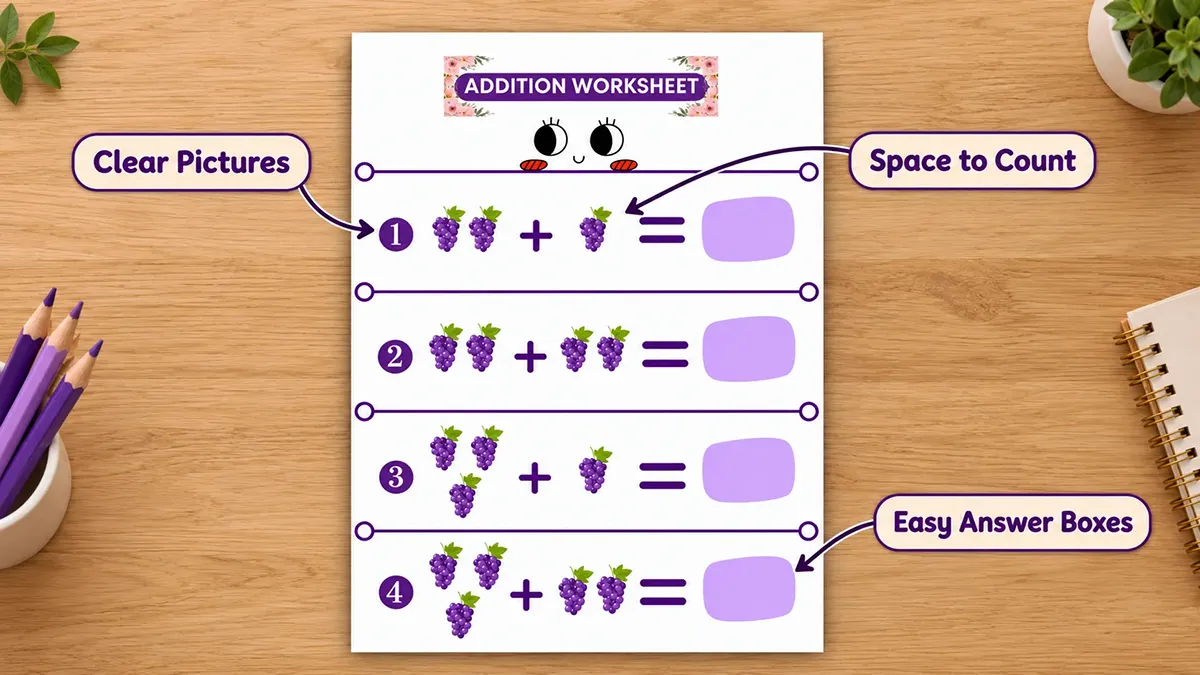
- Clear Starting Points: Look for picture groups that are easy to count and a clear space for the answer. You can write each group’s number nearby if there isn’t a separate box.
For targeted visual practice, object-based counting sheets like Bunny Picture Addition Worksheets give kids cute, relatable images to count and combine. Similarly, Grapes Picture Addition Worksheets give children fruit pictures to count, with a vertical layout and space to write their answers.
Parent Troubleshooting: Common Pitfalls & Quick Solutions
If your child struggles during picture addition sessions, refer to this troubleshooting table:
| What You Observe | Possible Reason | Practical Adjustment |
| Double-counting pictures | Weak one-to-one correspondence | Have them cross out or place a counter on each image as they say the number. |
| Forgetting how many pictures were in each group | Keeping both totals in mind may be difficult. | Write or place the matching number beside each group after counting it. Leave both groups visible, then count all the pictures together. |
| Confused by + and = signs | Premature introduction of symbols | Use spoken phrases like “and” and “makes” before introducing formal signs. |
| Losing focus quickly | Visual fatigue or sessions too long | Limit practice to 3–5 problems per session (5–10 minutes maximum). |
Frequently Asked Questions (FAQs)
Around ages 4 to 6 is a good time to try simple picture addition. Start with small groups your child can count comfortably, such as two apples plus one more. They don’t need to count to ten before trying these small totals.
Picture addition relies on visual representation and physical counting of drawn objects, whereas mental addition requires holding numerical values in working memory without visual aids.
There’s no fixed number of weeks. Show written numbers alongside the pictures from the start. When your child can explain how the two groups make the total, try a simple sum without pictures and see how it goes. Bring the pictures back whenever they need support.
Final Thoughts
Teaching picture addition is all about giving young learners a concrete, visual foundation for math. By walking through simple visual steps, using hands-on counting techniques, and utilizing clean practice sheets, you transform early arithmetic into an intuitive and enjoyable experience.
For a comprehensive roadmap on early childhood education and math skill progression, explore our master guide on Printable Worksheets for Kids: Your Complete Age-by-Age Guide.