

Quick Answer
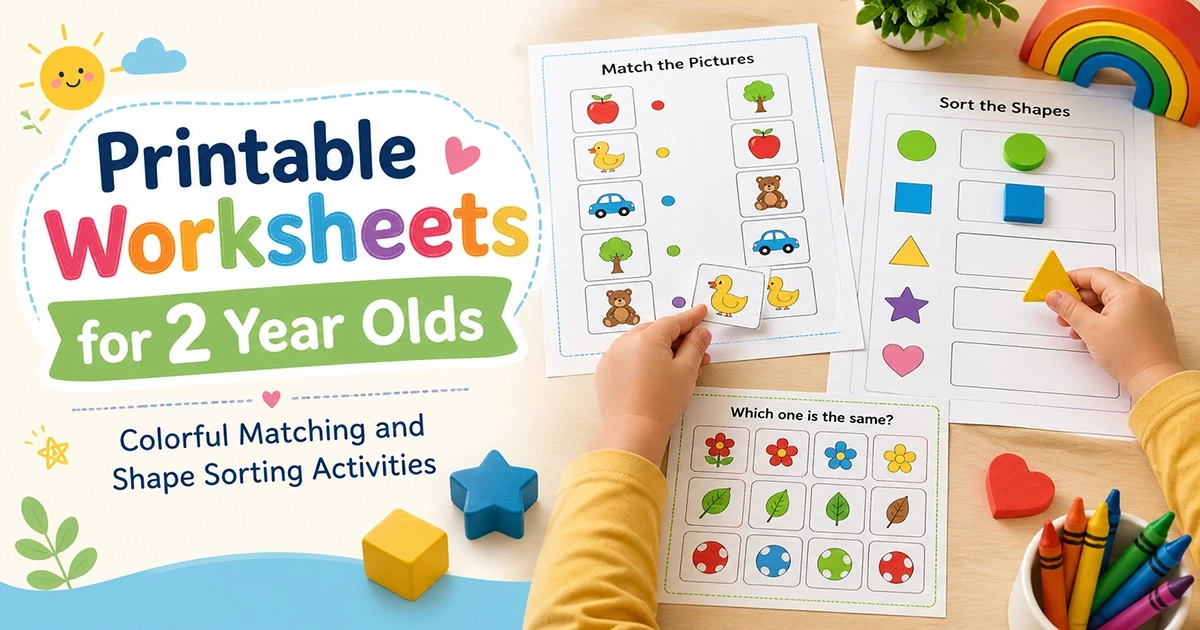
Printable worksheets for 2 year olds are hands on activity sheets built around matching, sorting, and basic recognition, without any tracing or pencil work. Toddlers use them with their fingers, stickers, clothespins, or small manipulatives while a parent sits alongside and guides them. The purpose is not to draw or write. The purpose is to build visual discrimination, early logic, color and shape recognition, and focused attention through short play sessions. Each sheet downloads instantly as a PDF, prints cleanly on a standard home printer, and can be laminated for repeat use. Used this way, a printable becomes a toddler play tool, not an academic task.
Table of Contents
- The Real Problem With Worksheets for 2 Year Olds and What Most Blogs Get Wrong.
- What Your 2 Year Old Can Actually Do With a Printable Sheet at This Age.
- Matching Activities That Build Visual Discrimination.
- Sorting and Color Recognition Activities That Strengthen Early Logic.
- Why Matching Printables Also Strengthen Your Toddler’s Hands.
- How to Set Up a Printable Worksheet So Your 2 Year Old Stays Engaged.
- Printing and Laminating Tips for Daily Home Use.
- Ready to Build a Simple Learning Routine at Home.
- Frequently Asked Questions.
The Real Problem With Worksheets for 2 Year Olds and What Most Blogs Get Wrong
Walk into any mothers’ group and you will find two opposite pieces of advice thrown at you in the same week. One side says your 2 year old is falling behind if they are not doing tracing sheets yet. The other side says worksheets are harmful for toddlers and you are pushing your child too early. Both groups sound confident. Both leave you feeling like whichever choice you make will somehow be the wrong one.
Here is the honest version. The industry consensus is partially correct. Traditional worksheets, the kind that expect a 2 year old to hold a pencil, trace letters, and sit still for fifteen minutes, are genuinely inappropriate at this age. A toddler’s pincer grip is still forming. Their attention span runs roughly four to six minutes on a single task. Their hands are built for grabbing, pointing, and dropping, not for pencil control. Expecting academic output from a 2 year old sets them up for frustration and sets you up for disappointment.
Most blogs stop thinking here. They lump every printed sheet into one category called worksheets and reject them all. We want to correct that error.
A printable asking your toddler to match a green leaf to a green jar using their fingertip is not a worksheet in the academic sense. It is a laminated play tool. A sheet where your child drops pom poms onto circles is not paper and pencil work. It is a hand strengthening activity that happens to be printed on paper. The problem was never the paper. The problem was always the pencil expectation attached to the paper.
When you remove the pencil and add your child’s hands, eyes, and curiosity, a printable becomes something completely different. It becomes something that actually suits a 2 year old.
What Your 2 Year Old Can Actually Do With a Printable Sheet at This Age
A 2 year old is doing far more cognitive work than most parents realise. Your child is building neural pathways every time they notice two things are the same, put an object into a container, or match a color they have seen before. The thinking skills forming at this stage keep deepening through the third year and lay the groundwork for every later learning milestone.
At 2 years, your child can reliably point at objects you name, pair simple colors, pick up small items with an improving pincer grip, follow one step instructions like “put the red ones here”, and recognise familiar animals, body parts, and everyday objects. What your 2 year old cannot yet do is sustain pencil control, sit through fifteen minute academic blocks, or manage multi step written tasks.
Matching, sorting, and recognition activities land in your child’s developmental sweet spot. They use skills your toddler already owns and stretch them gently.
That is exactly the gap well chosen printable activities for 2 year olds can fill. The right worksheets for toddlers age 2 work with your child’s current abilities, not against skills that are still a year or two away.
If you want the broader picture of how printable worksheets fit across ages from toddler to Class 2, our Complete guide to printable worksheets for kids walks through every stage.
Matching Activities That Build Visual Discrimination
Matching is the earliest form of visual thinking. When a toddler pairs two red balls together, they are telling you their brain has noticed a pattern. The same skill later helps your child tell the letter b apart from d, or spot the difference between the numbers 6 and 9.
Matching worksheets for 2 year olds work best when the pairs are visually clear and the action is simple. No drawing. No writing. Just looking, pointing, and placing.
A good matching activity at this age asks your toddler to do one of three things. Find the item that is the same. Find the item that belongs together. Find the item that matches a given color. The cognitive effort is already significant for a 2 year old, so the physical effort should stay light.
We built our Color matching game for kids on exactly this principle. Bright familiar colors, clear paired objects, and a format that works whether your child uses a fingertip, sticker, or small toy to indicate the match. Laminate the sheet once and you get months of repeat use without reprinting.
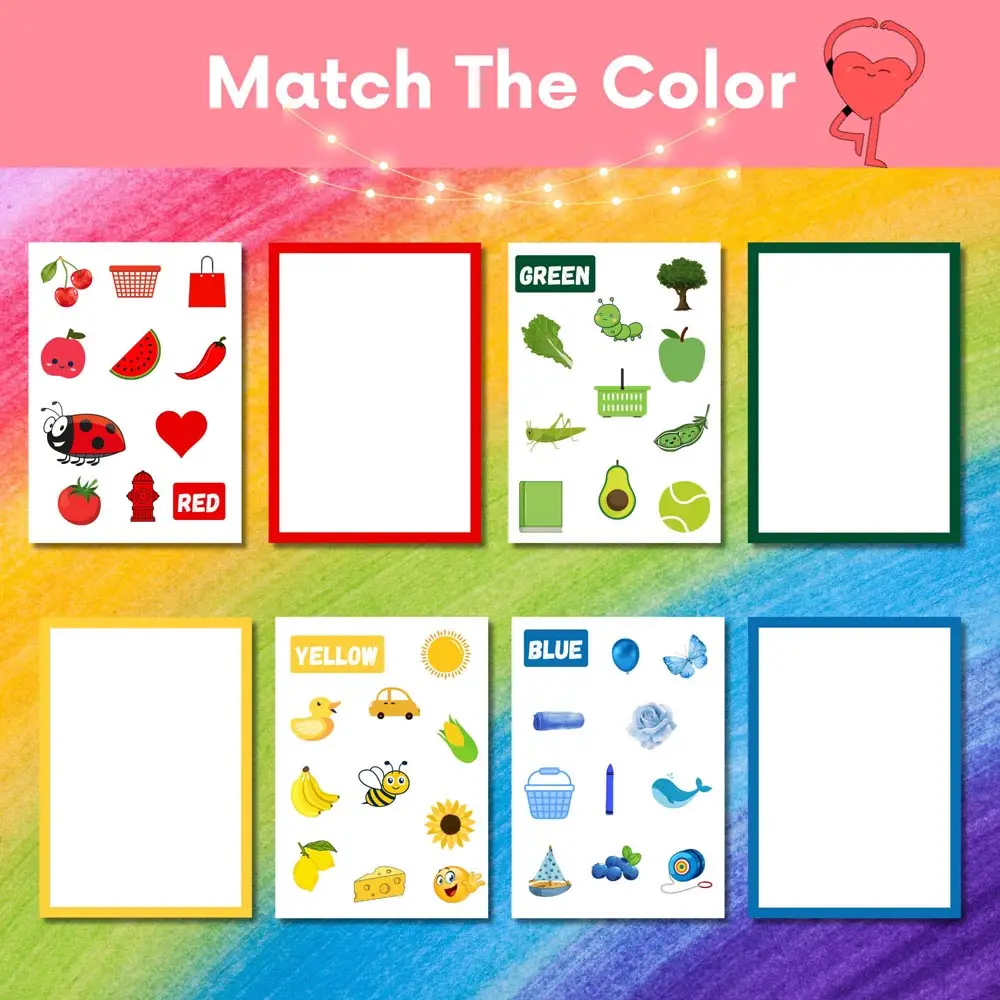
A common question is whether matching is too simple to count as real learning. It is not. When your toddler pairs two red items together, their brain is learning that things can be the same. That one idea quietly builds the ground for reading and maths later on.
Sorting and Color Recognition Activities That Strengthen Early Logic
Sorting moves one step beyond matching. Instead of pairing two items, your toddler has to decide where something belongs. Red goes here, blue goes there. Each item has a place, and finding that place is the whole point.
The thinking leap is real. Your toddler is no longer just recognising sameness. Your child is building early logic and categorisation. Early childhood researchers consistently find that children who sort and categorise objects at this age arrive at school with stronger attention and self regulation than those who skipped these activities.
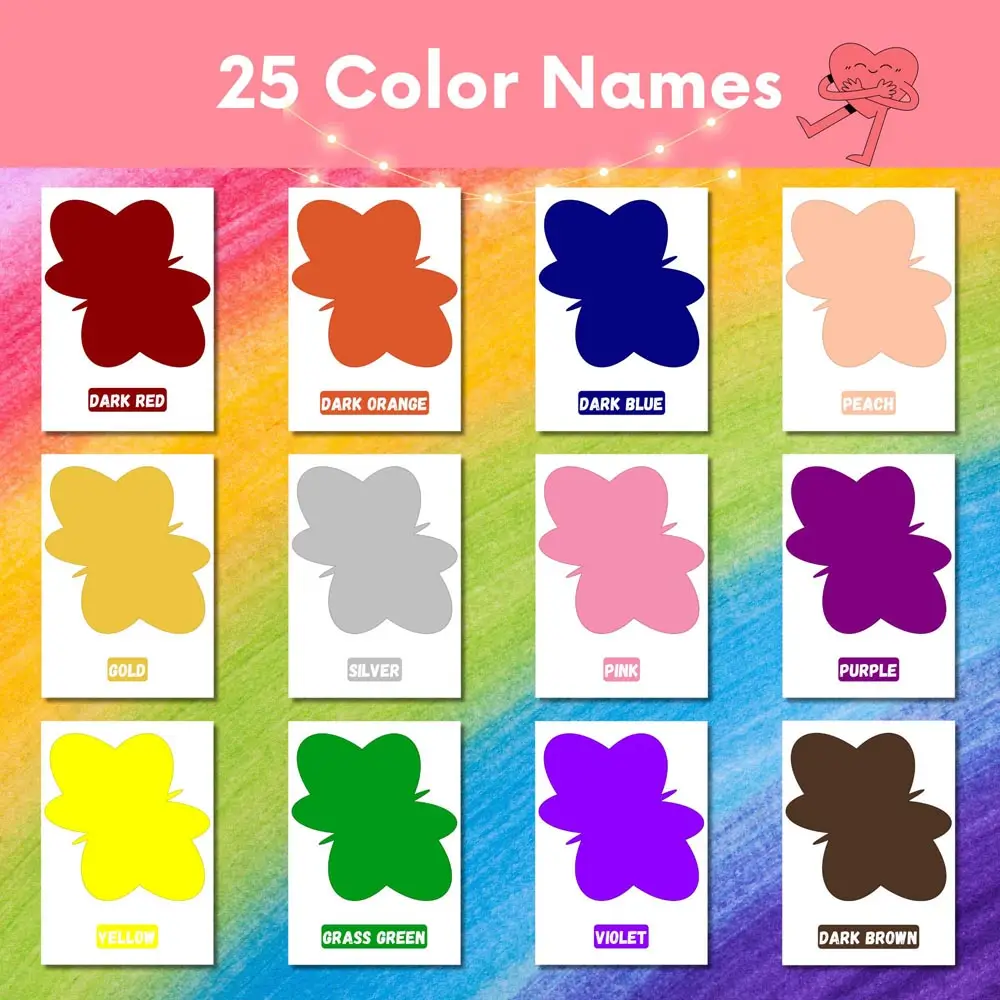
Color sorting is one of the simplest ways to start. Our Color sorting activity for kids gives your toddler colorful illustrated sheets where they place each item with its matching color. No reading required, no pencil needed. Just picking, placing, and sorting by what they see.
We tested several activity formats with toddlers in this age range and noticed one pattern worth sharing. Children stayed engaged far longer when they used a laminated sheet placed on the floor rather than a table, paired with a handful of loose objects like pom poms or buttons. The same sheet used flat on a table with a crayon lasted about two minutes before the child wandered off. The laminated floor version held attention for closer to ten. We carry that observation into how we build every toddler printable now.
Why Matching Printables Also Strengthen Your Toddler’s Hands
The cognitive work we just described rides on top of something physical. Every time your 2 year old picks up a pom pom and drops it on a matching circle, their pincer grip strengthens. Every sticker your child peels and places builds the same finger muscles they will eventually need to hold a pencil. Fine motor development is happening through play, not drills.
A few specific motor benefits are worth naming. Pincer grip, where thumb and index finger work together, develops fastest through small object manipulation. Pom poms, buttons, or dry pasta used with a laminated sheet give your toddler daily grip practice without a single pencil in sight.
Using both hands for different tasks develops when one hand holds the sheet steady while the other places an object. A 2 year old might not hold the sheet down naturally at first. Show your child once, and they will pick it up quickly. Watch for the moment they do it without a reminder. That small shift, both hands working together on their own, is a real developmental milestone happening quietly on your living room floor.
Hand eye coordination improves with every accurate placement. Missing the target circle and adjusting teaches your child’s brain how to connect what they see with what their hand does.
When tracing sheets become age appropriate at 3 or 4, these exact foundations make the transition smooth. We think of matching printables as the quiet preparation for every later paper based skill.
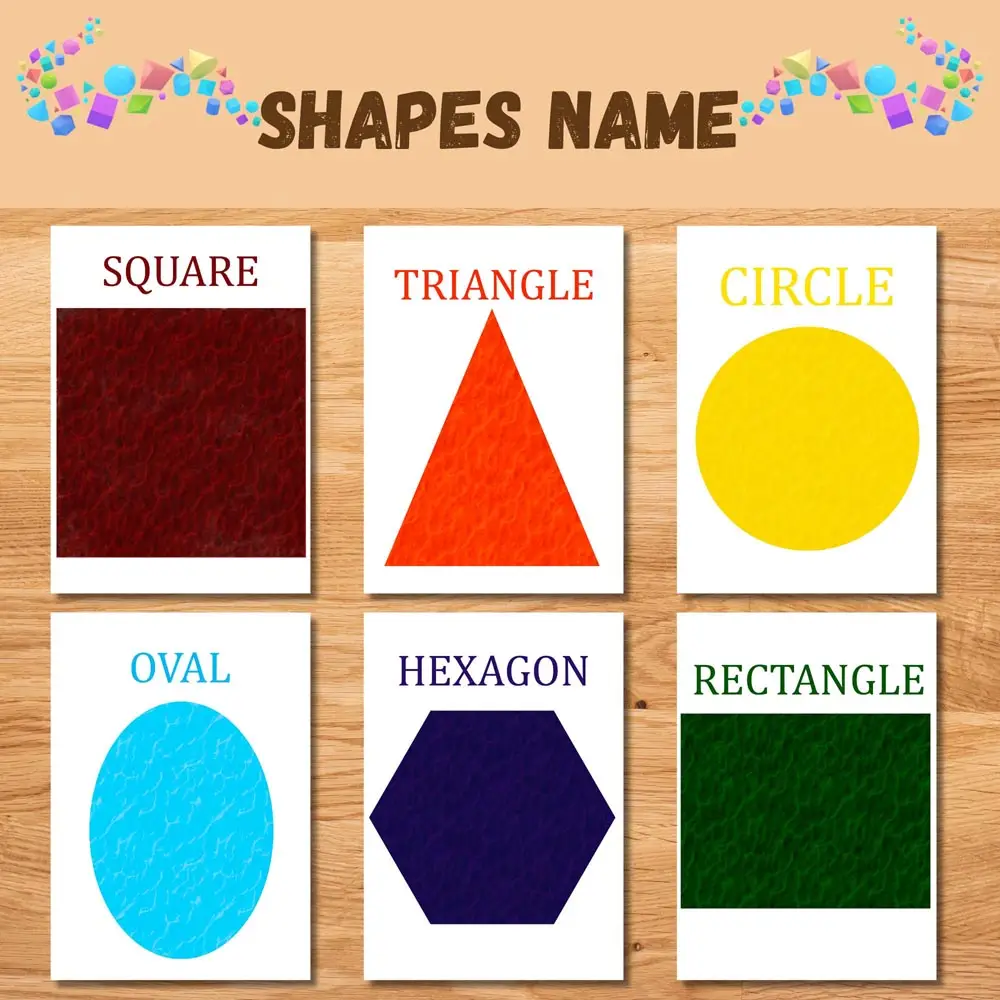
Our Shape flashcards for kids work well here too. Each card shows a bold clear shape your toddler can point to, match against objects around the room, or sort into groups. No reading needed, just looking and recognising.
How to Set Up a Printable Worksheet So Your 2 Year Old Stays Engaged
Setup matters more than the sheet itself. A good printable used poorly still fails. A simple printable used well looks like magic.
Laminate the sheet before anything else. A 2 year old will grab, fold, and occasionally chew the edges. Lamination at 3 mil or thicker makes the sheet survive daily use and turns it into a surface your child can touch confidently. A basic pouch laminator does the job and most cost less than you would expect.
Pom poms, large buttons, mini erasers, clothespins, or even dry cereal give your toddler something to hold and place. The action of picking up and putting down builds fine motor skills and gives your child half the developmental benefit of the activity. Without something small to handle, the sheet is just a flat picture.
Keep sessions short. Four to six minutes is the realistic attention span at this age, and that is not a failure. It is simply how a young brain works. Three brief sessions spread across a day will teach your child more than one long forced session that ends in tears.
Sit next to your child, not across. Narrate what they are doing as they work, something like “You found the red one. There it goes next to the other red one.” Parallel talk doubles the language benefit of the activity without adding any effort on your part.
Celebrate the trying, not the correctness. A 2 year old who places a yellow pom pom on a red circle has not made a mistake. They have made a discovery about colors and their own hands. Correct gently if needed, or simply move on. The goal is willingness to engage, not accuracy.
Rotate activities. Same printable every day becomes boring by day four. Three or four different sheets in rotation keep your child curious without overwhelming them with choice.
We recommend balancing printable play with movement, pretend play, books, and sensory time throughout the day. The best activities for 2 year olds at home work best when they sit between these moments, not instead of them. Printable work earns its place as part of a broader screen free day, not instead of running, playing, or reading together.
For the learning corner where you use these sheets, our Cute animal wall art collection has soft toddler friendly prints. They warm up a playroom without feeling cluttered or overstimulating.
Printing and Laminating Tips for Daily Home Use
Printable worksheets for 2 year olds work on any standard home printer in PDF format. No special equipment. Most parents wonder whether their home printer will handle these files well. It will. Any basic inkjet or laser printer from the last five years handles them cleanly. A few settings choices make a real difference to the result.
Paper matters. Regular 80 GSM copy paper works for one time use, but a 2 year old will tear or crumple a thin sheet in minutes. For anything you plan to laminate, switch to 180 to 250 GSM cardstock. The extra stiffness holds up through handling, and colors come out richer on thicker paper.
Print at 100 percent scale, not fit to page. Fit to page shrinks the worksheet and makes the activity zones smaller than the original size. A toddler’s motor control needs larger targets to feel successful, so keep the original proportions.
Choose high quality or best color in your settings. The ink cost difference is minimal on a single sheet, and the sharper output makes color recognition easier for your child.
Matte paper is better than glossy. Glossy paper glares under ceiling light and makes the images harder for a toddler to focus on. Matte feels calmer on the eye and fingers.
Once done, laminate each sheet using a pouch laminator at 3 mil or higher thickness. Round off the corners with scissors to remove any sharp edges. The whole process takes about five minutes per sheet and gives you a play tool that lasts for months. We create every printable in this age range to come out clearly on basic home setups, so you never need a commercial printer to get a good result.
Ready to Build a Simple Learning Routine at Home
You do not need a stack of expensive workbooks or an hour of daily dedicated time. You need a few well-chosen toddler learning printables, a laminator, and the confidence that matching, sorting, and pointing are real learning for a 2 year old. Browse our Educational templates collection to find printable matching and sorting activities made for your toddler. Every sheet downloads instantly, comes out crisp at home, and becomes a laminated play tool after a few minutes of setup.
FAQ
Traditional pencil and paper worksheets are not appropriate for 2 year olds because their pincer grip and attention span are still forming. Matching, sorting, and recognition printables used as hands on play tools with fingers, pom poms, or stickers are appropriate and work well when kept to short four to six minute sessions with a parent.
The right type of printable is appropriate for toddlers. The key difference is the expectation attached. A laminated matching sheet used with pom poms or stickers is a play tool. A tracing sheet expecting pencil control is not yet suitable at this age. Choose based on the skill being practiced, not the label on the product.
Good home activities for a 2 year old combine movement, language, and hands on play. Matching color objects to cards, sorting soft toys, pointing at pictures in books, stacking cups, and using laminated printables with manipulatives all build core skills. Aim for three to four short bursts across the day.
Four to six minutes is realistic for most 2 year olds. Some children settle for closer to ten minutes on a highly engaging activity with a parent alongside. Plan for short sessions and stop when your child loses interest. Forcing more time than their brain is ready for makes them pull away from learning activities altogether.
Yes, and the format we actively recommend at this age skips tracing entirely. Non tracing printables focus on matching, sorting, color and shape recognition, and pointing tasks. Your child uses their fingers, stickers, or small objects instead of a pencil. The thinking happens without any pencil demand, and that is exactly where a 2 year old belongs.