

Quick Answer Box
Teaching Hindi Varnamala at home works best when you start with the 13 vowel-sound letters (Swar and Ayogvah from अ to अः) using picture-sound associations before introducing consonants. Once vowels are comfortable, group the first 25 Vyanjan into their five sound families, then introduce the remaining letters gradually. and focus on sensory warmups and top-line (Shirorekha) balance before starting paper-and-pencil writing. Short, 5-minute daily sessions keep practice fun and prevent overwhelm.
Table of Contents
- The Real Reason Hindi Letters Feel Different from English
- The Step-by-Step Method to Teach Hindi Varnamala at Home
- Step One: Start with Swar (Vowels) First
- Step Two: Use Picture and Sound Association
- Step Three: Group Vyanjan into Small Sound Families
- Step Four: Tactile Warmups and Shirorekha Practice
- Fun Home Activities for Daily Hindi Practice
- Choosing Low-Pressure Hindi Tracing Printables
- Quick Summary Cheat Sheet for Parents
- Frequently Asked Questions (FAQs)
- Final Thoughts
The Real Reason Hindi Letters Feel Different from English
Watching a young child transition from English alphabets to Hindi Varnamala often reveals an unexpected hurdle. While English letters rest neatly on a bottom baseline using predictable vertical and diagonal strokes (like A, T, or L), Hindi script hangs down from a top line known as the Shirorekha and incorporates circular loops, floating curves, and vertical standing lines called Khadi Pai.
To a preschooler, an English letter looks like a few standalone sticks, whereas a Hindi letter feels like a complex drawing that requires holding stroke balance from above rather than below.
When children push back against Hindi practice, they are rarely resisting the language itself. They are simply adapting to a completely different set of fine-motor demands. By shifting our teaching approach from rigid memorization to stroke-by-stroke confidence, we turn Hindi learning into a smooth, natural habit at home.
The Step-by-Step Method to Teach Hindi Varnamala at Home
When deciding how to teach hindi varnamala at home, sequence is everything. Jumping directly into writing consonants in two-line notebooks often leads to frustration. Here is a simple home routine you can adjust to your child’s pace.
Step One: Start with Swar (Vowels) First
Some curves in Hindi letters may remind your child of shapes they already know. Use that only when it helps them notice the letter shape the complete introductory set of 13 letters from अ to अः (अ, आ, इ, ई, उ, ऊ, ऋ, ए, ऐ, ओ, औ, अं, अः).
In formal Hindi grammar, this set consists of 11 core Swar and 2 Ayogvah (अं and अः). However, early tracing worksheets and preschool activity sets present all 13 letters together so children get a complete, continuous introduction before moving to consonants.
Because many of these letters share visual similarities with the digit 3 (like अ, आ, उ, ऊ, ओ, औ, अं, अः), point out this familiar curve to your child. Children who already recognize basic numbers find these curves intuitive and far less intimidating to copy.
Focus on oral recognition first. Sing the Swar sequence together during playtime or morning routines before introducing printed flashcards or worksheets. Following a simple Swar and Vyanjan sequence also makes it easier to introduce new letters gradually.
Step Two: Use Picture and Sound Association
Young minds remember visual stories far better than abstract letter shapes. Always pair every Hindi letter with a distinct, familiar starting sound.
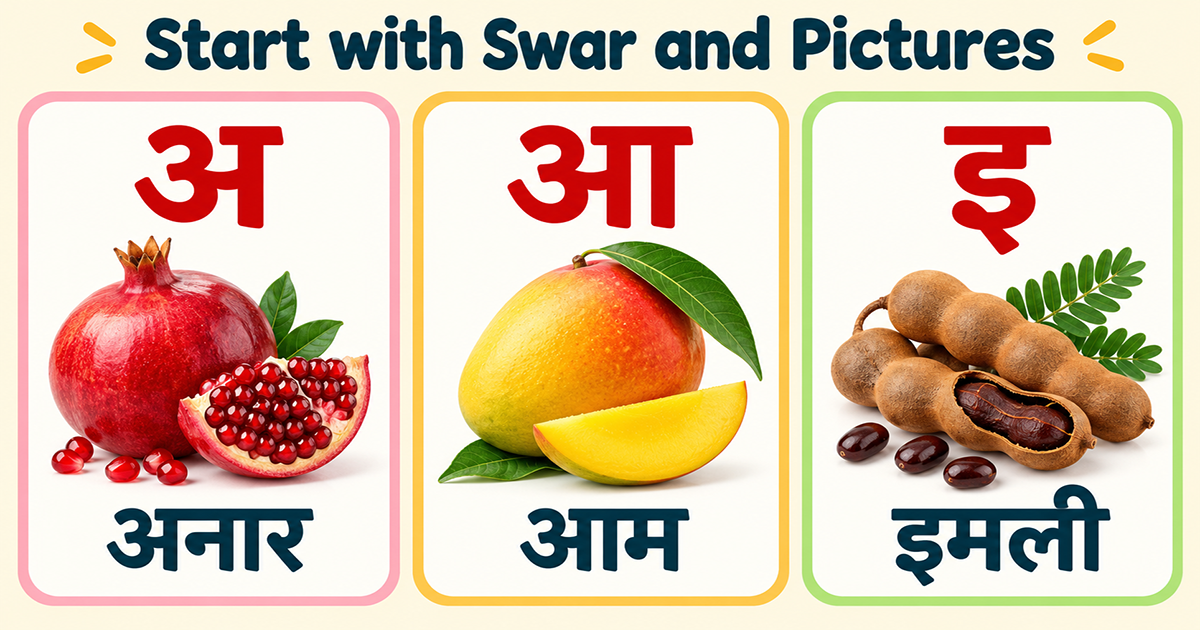
Wondering how to teach Hindi Varnamala to a preschooler using pictures? Start with something your child knows, like a mango. Say “aam” together, then show them आ.
- Connect अ with अनार (Anaar / Pomegranate)
- Connect आ with आम (Aam / Mango)
- Connect इ with इमली (Imli / Tamarind)
- Connect अं with अंगूर (Angoor / Grapes)
When reviewing a letter, point to the picture first and ask, “What fruit is this?” Once your child says “Aam,” guide them to make the opening phonetic sound: “aa-aa-aam.” This connects auditory phonics with the visual symbol naturally. As you learn how to teach Hindi Varnamala to a preschooler, give your child a turn too: let them pick the next picture, then say the word together.
Step Three: Group Vyanjan into Small Sound Families
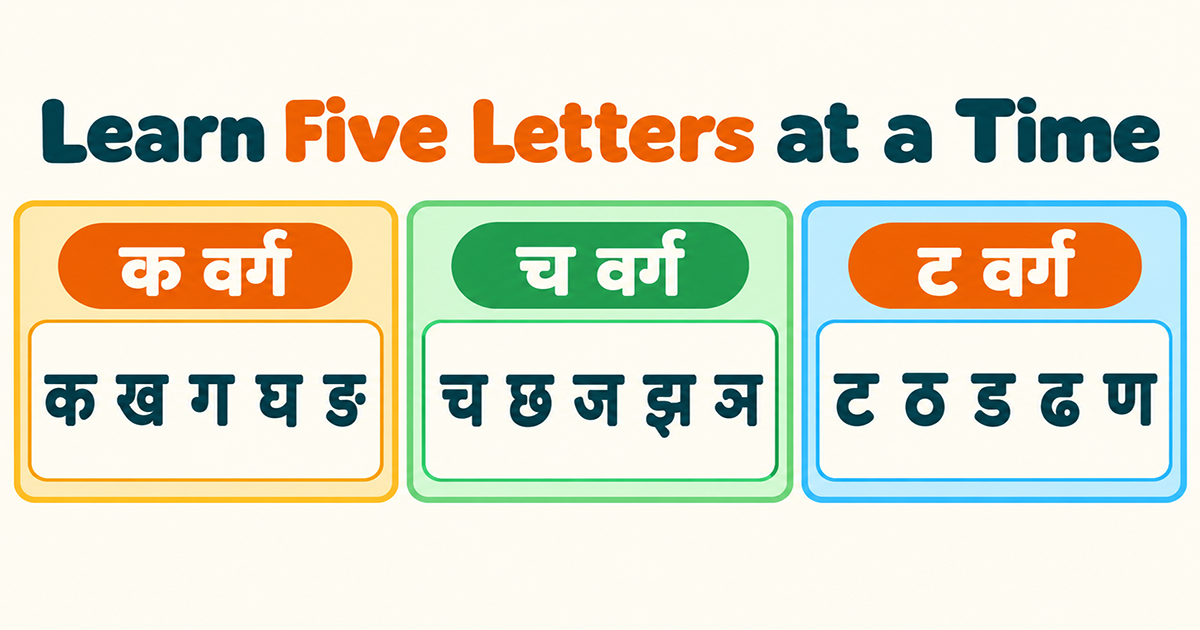
The biggest mistake in early Hindi instruction is presenting all 33 Vyanjan in one continuous list. Instead, Start with the five traditional Varg groups. These cover the first 25 Vyanjan: क-वर्ग, च-वर्ग, ट-वर्ग, त-वर्ग, and प-वर्ग. After that, introduce य, र, ल, व, श, ष, स, ह separately.
- क-वर्ग: क, ख, ग, घ, ङ
- च-वर्ग: च, छ, ज, झ, ञ
- ट-वर्ग: ट, ठ, ड, ढ, ण
- त-वर्ग: त, थ, द, ध, न
- प-वर्ग: प, फ, ब, भ, म
Introduce only one 5-letter family per week. Master the oral sounds and recognition of that family completely using quick weekend matching games before moving on to the next set.
Step Four: Tactile Warmups and Shirorekha Practice
Before asking your child to hold a tight pencil grip, let them trace Hindi letter strokes using sensory methods.
- Sand Tray Tracing: Spread clean craft sand or kinetic sand on a tray and let your child draw letters using their index finger.
- Playdough Letters: Have your child roll playdough into long, thin strands or ropes to form the curves of letters.
- The Shirorekha Rule: On many handwriting practice pages, it helps to form the main shape first and then add the Shirorekha as the finishing line the top horizontal line (Shirorekha) last as a finishing touch.
Fun Home Activities for Daily Hindi Practice
Keeping Hindi practice light and interactive is an easy way to learn Hindi Varnamala at home without making practice feel heavy. Here are three simple games you can play at home:
- Letter Hunt: Spread 4 or 5 Hindi letter flashcards on the floor. Call out a sound like “ka” and ask your child to jump on the card showing क.
- Matching Pairs: Draw a picture on one side of a page and place 3 letter choices on the other side. Ask your child to draw a line connecting the picture to its correct starting letter.
- Back Tracing (Magic Touch): Gently trace a Hindi letter on your child’s back or palm with your finger and ask them to guess the letter by feel.
Choosing Low-Pressure Hindi Tracing Printables
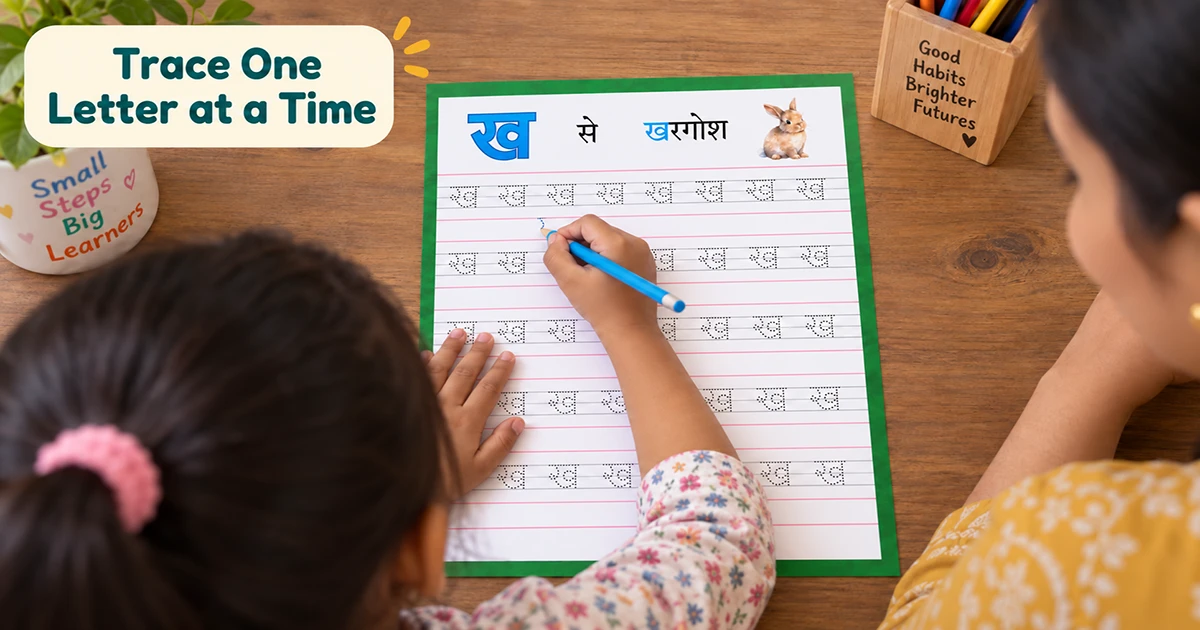
When your child is ready to move from sensory tracing to paper practice, choose Hindi letter tracing pages with clear guides and enough white space. Dense, crowded worksheets can make it harder for children to focus on one letter at a time.
Look for printable pages with clear tracing guides and enough white space for comfortable practice. Varnamala Tracing Worksheets gives children one character at a time, covering Swar and Ayogvah, 33 Vyanjan, and common Hindi practice characters such as क्ष, त्र, and ज्ञ. This keeps the page focused and gives children room to practise at their own pace.
If your child is practicing English and Hindi simultaneously, you can also balance their daily table time by pairing Hindi practice with clean Alphabet Tracing Worksheets from our Educational Worksheets Collection.
Quick Summary Cheat Sheet for Parents
Use this simple guide when your child gets confused between similar Hindi letters:
| Letter Pair | Key Difference to Point Out | Simple Teaching Tip |
| क vs फ | क loops inward on the right; फ curves downward like a hook. | Tell them क stays tucked in, while फ reaches down like an umbrella handle. |
| घ vs ध | ध has a small top loop and a split top line; घ is full and open. | Show that the top line (Shirorekha) never covers the top loop on ध. |
| ब vs व | ब has a diagonal line inside its belly; व is empty inside. | Call ब the letter with a seatbelt across its tummy. |
| प vs ष | ष has a diagonal line across its center; प is completely clear. | Explain that ष looks like प wearing a shoulder sash. |
Frequently Asked Questions (FAQs)
Around ages 3 to 5 is a practical time to begin teaching Hindi letter sounds at home. Start with sounds and picture words, then add short tracing practice when your child can comfortably copy simple lines and shapes. About five minutes at a time is a gentle starting point.
If your child is just starting, teach Swar first because they are easier to sing, see, and connect with pictures. Once those feel familiar, add Vyanjan in small groups.
Focus on one key distinguishing feature. For example, show them that ब has a diagonal slash inside its belly, while व is completely open inside.
Final Thoughts
Learning Hindi Varnamala does not have to be a source of stress or resistance. By breaking the alphabet into bite-sized steps, using sensory warmups, and providing clean practice pages, you transform home learning into a smooth, rewarding journey.
For more age-appropriate practice ideas and developmental learning guides, visit our complete resource: Printable Worksheets for Kids: Your Complete Age-by-Age Guide.